A review lands, and the same three questions follow every time: should you reply at all, what do you write, and how much of your week should this take. Learning how to respond to Google reviews is usually taught as an absolute rule, with an implicit promise attached: reply to everything and you will rank higher. What Google actually documents is more nuanced, and that is good news if you do not have three hours a week to spend on your Business Profile.
This guide covers the whole job: what your replies actually change, which reviews deserve priority, what to write when the review is hostile or false, and the phrasings that expose your profile to moderation or to a legal problem. With templates you can adapt, for a silent five-star as much as for an unfair one-star.
💡 The essentials in 30 seconds
- Google advises replying when you have something useful to add, not to every single review.
- What moves local ranking is the number of reviews and the ratings, not your reply rate.
- Your reply is public, moderated by Google, and your personal name is never shown.
- The reviewer gets notified, and a good reply can convince them to update their rating.
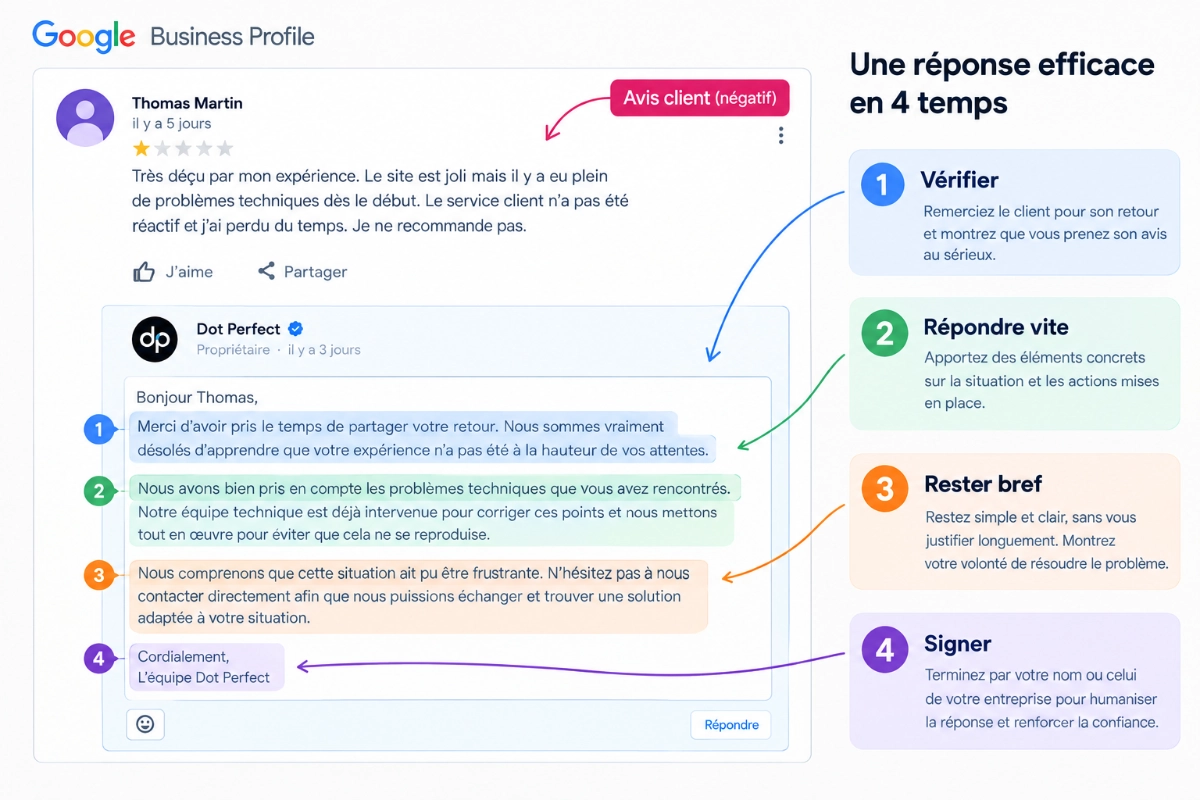
- Handle a negative review in four steps: acknowledge, admit, explain, move it private.
- Never put personal details about a customer in a public reply, even to set the record straight.
📈 What replying to reviews actually changes for your visibility
Google documents three local ranking factors: relevance, distance and prominence. Prominence is based partly on how many links point to your business and how many reviews you have received, and Google states that more reviews and positive ratings improve your local ranking.
Read that carefully. Review count and rating quality. Not reply rate. No official documentation makes owner replies a ranking factor.
What your replies do achieve:
- They speak to future customers, not to the algorithm. A column of unanswered one-stars tells a story, and it reads in three seconds.
- They can move a rating. Reviewers are notified when you reply, and they can edit their review afterwards.
- They feed your overall rating indirectly, by making satisfied customers more comfortable contributing in turn.
- They force you to read what customers actually say, which remains the best free source of improvement available to a small business.
The blunt conclusion, and it contradicts most of what is written on this subject: replying will not move you past a competitor in the local pack. Failing to reply to a substantiated negative review can absolutely cost you the phone call. This is conversion work, not SEO work. If your goal is position, the first place to look is the completeness of your profile (EN-SLUG-TO-CONFIRM: Google Business Profile audit page).
🛠️ The four-step method that works for any review
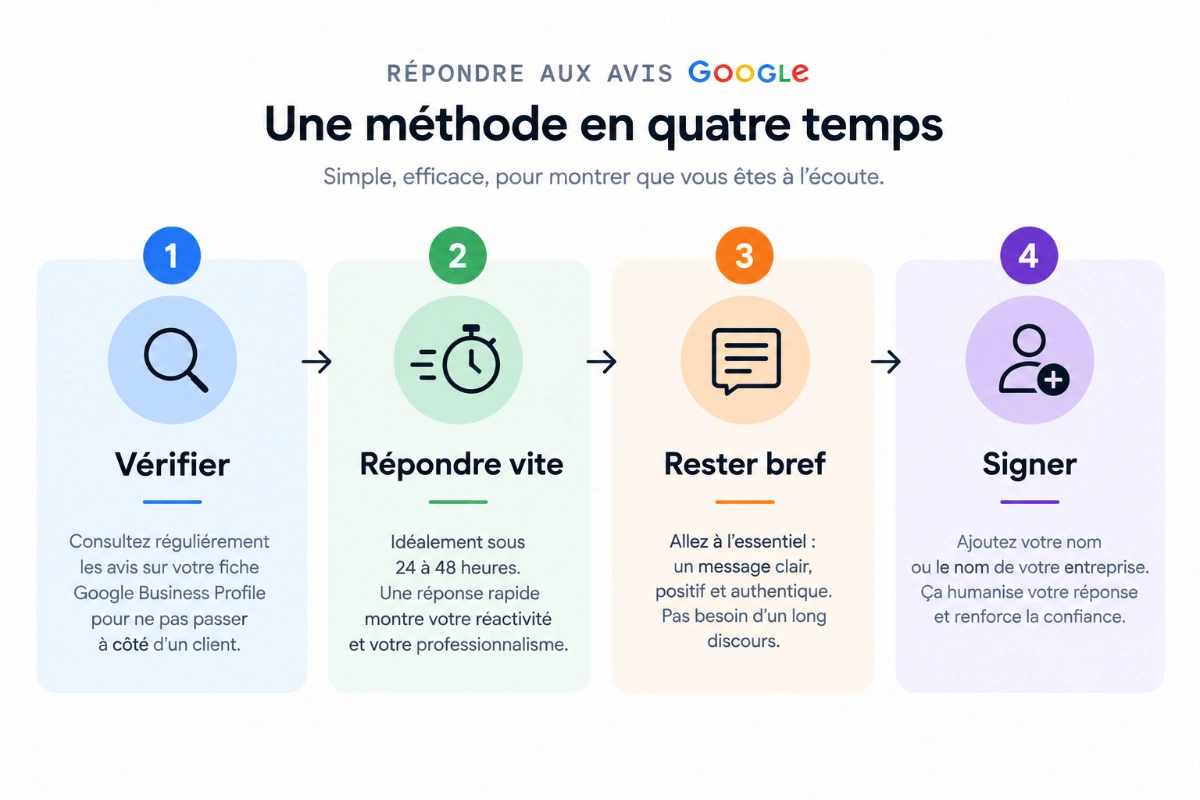
Before the templates, there is a sequence that holds whatever the star rating is. It takes four moves.
- Check before you write. Find the job, the date, the person who handled it. A reply built on an approximation gets destroyed in the next comment.
- Reply quickly, not instantly. Google recommends replying promptly to show that feedback matters. On a review that makes you angry, let a few hours pass: the text stays online for years.
- Keep it short. Google is explicit about this: replies that run long lose the reader before the point lands. Two to four sentences is almost always enough.
- Sign it. Adding your first name or initials at the end makes the reply feel human, and it is an official Google recommendation.
Two official guidelines complete the sequence, and both are widely ignored. Google asks you to stay professional and polite, and above all not to turn the reply into a sales pitch: the person who wrote the review is already a customer, they do not need a promotion. Give them a piece of information they did not have instead.
💬 Positive reviews: three situations, three templates
A positive review takes one minute, provided you know which one deserves more than a line. Google's own guidance is to stop sending the same thank-you to everyone and to focus on the reviews where you can share a useful update or answer a question.
Case 1. The five-star with no comment. Nothing to pick up on, nothing to add. One line, or nothing at all if your week is full.
Thanks for the rating, James. See you next time at the workshop. Sonia
Case 2. The detailed five-star. Here you have material. Pick up the detail they mentioned, add something useful for the next reader, sign.
Thank you Sophie, delighted the cut worked out. We now hold a Thursday evening slot until 8pm if daytime appointments are difficult for you. See you soon. Ella
Case 3. The four-star with a reservation. The most useful of the three, and the one most often fumbled. Deal with the reservation in one sentence, without a defensive justification.
Thanks for the feedback, Mark. You are right about the lunchtime wait: we added a second person in the kitchen on Fridays last month. The rest worked for you, and that is what counts. Tom
All three templates share one thing: they contain information the next reader did not have. That is what separates a useful reply from an acknowledgement of receipt.
ℹ️ Good to know
"Thanks for your feedback, see you soon" repeated fifty times in a row is the worst of both worlds: it costs you time, it tells the reader nothing, and it signals to anyone scrolling your profile that nobody is really reading. Ten useful replies beat fifty empty ones.
🧯 Negative reviews: replying without making it worse
This is where the whole thing is decided. A well-handled negative review reassures more than a wall of five stars, because it shows how you behave when something goes wrong. Google itself notes that a mix of positive and negative feedback often reads as more trustworthy.
The four-step frame: acknowledge, admit what can be admitted, explain without dodging, offer a private channel. Google explicitly recommends owning genuine mistakes without accepting responsibility for things that are not your fault, and allows you to invite the reviewer to contact you directly.
Case 1. The complaint is justified. You got it wrong, say so. It is the most effective reply there is, and the rarest.
You are right, and I am not going to look for an excuse: the vehicle should have been ready on the Friday as agreed. The part arrived late and we should have called you that morning. Get in touch with the workshop and we will pick the job back up with you. Dan
Case 2. You disagree on the facts. Stay factual, do not contradict head-on, and do not narrate the file in public.
Hello Mr Barrett. I understand your disappointment about the final figure. The work was quoted and signed off before it started, and two additional items were approved in writing while it was under way. I would rather go through it with you line by line, so please do get in touch. Steve
Case 3. A reviewer you cannot identify. Do not accuse them of being a fake customer. Say plainly that you cannot find the visit.
Hello, your comment surprises us and we cannot find an appointment matching this username. If you did come to the practice, please call us and we will look into what happened. Hannah
Case 4. The extortion attempt. A negative review paired with a demand for payment or free work in exchange for removal is not a writing problem. Do not negotiate, do not argue the substance, and report it through Google's dedicated process for review extortion scams.
⚠️ Warning
Never publish private information about a reviewer, and never attack them personally. Google states this as an explicit rule, and most jurisdictions add a second layer of risk on top of it. Naming a medical detail, an unpaid balance, an address or an appointment history in a public reply is a serious mistake even when you are the one in the right. A Business Profile is not a courtroom, and a reply written in anger can expose you to a claim the review itself never could.
📊 Which reviews deserve priority
Not all reviews carry the same weight. This grid is for the moment when you have fifteen minutes and thirty unanswered reviews.
| Review type | Reply? | Target delay | Length |
|---|---|---|---|
| One or two stars, substantiated | Always | Under 48 hours | 3 to 5 sentences |
| Three stars, mixed | Always | Under a week | 2 to 3 sentences |
| Five stars, detailed | Yes | Under two weeks | 2 sentences |
| Four stars with a reservation | Yes | Under a week | 2 to 3 sentences |
| Five stars, no text | If you have time | No urgency | 1 sentence |
| One star, no text | Once, soberly | Under a week | 1 to 2 sentences |
| Off-topic or extortion | No, report it | Immediately | None |
The reading is simple: the bottom of the table is comfort, the top is revenue. Clear the first two rows every week and you have already done 80% of the useful work.
🚫 The six mistakes that cost the most
- Copy and paste. Five identical replies in a row are visible instantly and cancel the effect you were after.
- Replying in anger. It is always too long, always too defensive, and it stays online for years.
- The sales pitch. Google explicitly advises against offers and promotions in replies: the person is already a customer.
- The public goodwill gesture. Offering a discount, a free product or a credit in exchange for changing or removing a review is fake engagement under Google's policy, strictly prohibited, and it exposes your profile to restrictions.
- The detail that identifies the customer. Date, treatment, amount, personal circumstances: none of that belongs in a public reply.
- Long silence on negative reviews. Six months of nothing under a substantiated one-star leaves a single version of events on public display.
ℹ️ Good to know
Google allows you to invite a reviewer to contact you by phone or email. At the same time, the Maps user contributed content policy files phone numbers, email addresses and external links under advertising and solicitation. The safe phrasing is therefore to point people to the contact details already published on your profile, rather than typing a number into the reply itself.
🤖 Automating replies without sounding automated
Past roughly thirty reviews a month, manual writing always falls behind. Not through lack of goodwill: writing a decent reply means rereading the review, retrieving the context and finding the right tone, three times a day.
That is precisely the job covered by Pharelio's AI review replies. It works in three steps: your Google reviews appear in the dashboard, the AI drafts a reply matched to the tone of each review, then you read it, edit it if needed, and publish. You choose the register, professional, warm or empathetic, you can clear every outstanding review in one pass, and you keep a full history of what went out.
What automation will never do for you, and this matters:
- It does not know what happened in your workshop on 12 March. On a factual dispute, review before publishing is not optional.
- It does not decide whether a review should be reported rather than answered.
- It does not replace a phone call when the customer deserves better than a public reply.
The right way to see it: the tool writes the first draft and absorbs the mental load, you keep the judgement and the signature. The rest of the local visibility work, posts, photos and profile completeness, runs from the same place (EN-SLUG-TO-CONFIRM: Google Business Profile posts guide) (EN-SLUG-TO-CONFIRM: Google Business Profile photos guide).
⭐ Our recommendation
Start with the free profile audit: it reviews over 80 points and shows where you are actually losing visibility, reviews included. If review management is your weak spot, the Pro plan includes AI review replies from €15 per month billed annually, with a 14-day trial and no credit card.
🎯 What to do, depending on your situation
- ✅ Fewer than three reviews a month → Manual, as they come in, using the templates above. You need nothing else.
- ✅ Restaurant, salon or shop with 10 or more reviews a month → A fixed slot once a week, three in-house templates, and a tool the moment a backlog appears.
- ✅ Tradesperson or mobile service provider → Reply from your phone, but keep negative reviews for the evening, calmly, never between two jobs.
- ✅ Several locations → A written reply policy and a centralised tool, otherwise every site invents its own tone. The (EN-SLUG-TO-CONFIRM: pricing page) includes a multi-location plan for this case.
- ✅ Regulated professions: healthcare, legal, financial advice → Minimal, neutral replies, no case detail, and never confirm publicly that someone is a client.
- ❌ Full automation with no review step → Avoid in every case. A reply generated and published without a check will eventually validate a complaint that was never true.
🏁 Conclusion
Knowing how to respond to Google reviews is not a ranking lever, and pretending otherwise helps nobody. It is a trust lever, measurable on calls and direction requests long before it shows up in a position. The right target is not a 100% reply rate, it is zero unanswered negative reviews and replies that teach the next reader something.
The rest is organisation. One frame, a few in-house templates, a fixed slot in the week, and a tool on the day volume outgrows what you can absorb by hand.
Take action:
- Open your profile and list the negative reviews still unanswered. Handle the three most recent today, using the four-step frame.
- Write three in-house templates, one positive, one mixed, one negative, and keep them somewhere you will find them again.
- Run a free profile audit to see what replying to reviews cannot fix on its own.
Start the free audit No credit card · No commitment
📚 Sources
- Manage customer reviews, Google Business Profile Help
- Tips to get more reviews and to write better review replies, Google Business Profile Help
- Improve your local ranking on Google
- Prohibited and restricted content, Google Maps user contributed content policy
- Report inappropriate reviews on your Business Profile
- Report review extortion scams on your Business Profile
🔗 Useful resources
- (EN-SLUG-TO-CONFIRM: Google Business Profile optimisation guide 2026)
- (EN-SLUG-TO-CONFIRM: Google Business Profile posts guide)
- (EN-SLUG-TO-CONFIRM: Google Business Profile photos guide)
- (EN-SLUG-TO-CONFIRM: Google Business Profile audit page)
- AI review replies
- All features
- (EN-SLUG-TO-CONFIRM: Google review link generator)
- (EN-SLUG-TO-CONFIRM: Google review calculator)
❓ FAQ
Do you have to reply to every Google review?
No, and Google says so: you do not need to thank every reviewer publicly. Reply when you have relevant or new information to share. Negative and mixed reviews, on the other hand, deserve a reply every time.
How fast should you reply to a review?
Within 48 hours for a negative review, within a week for everything else. Google recommends replying promptly to show that customer feedback matters. The one exception is the review that makes you angry: a few hours of distance beats a reply you regret.
Does my personal name appear in my reply?
No. Google states that the reply appears as coming from your business and that your personal name is not shown. That is exactly why a manual sign-off at the end, a first name or initials, changes how the reply reads.
Why is my reply not showing under the review?
Because it is still being checked. Google reviews every reply against its content policies: the check usually takes about ten minutes, but it can take up to 30 days. If the reply is not approved, you will be asked to edit it before it can be posted.
Can I edit or delete a reply I have already published?
Yes, at any time, from the reviews section of your profile. A reply written in anger two years ago can be rewritten today. It is a clean-up almost no owner thinks of doing, and it is worth the hour.
Can a negative review be removed?
Only if it breaks Google's content policies: off-topic, abusive, promotional, or an extortion attempt. A review that is simply unfavourable but genuine will not be taken down, and that is as it should be. In that case the only useful option left is a good public reply.
Written by hand or generated by AI?
It depends on volume, not on principle. Below five reviews a month, write them yourself: you will be faster than any tool. Above ten, assisted drafting with a mandatory review step is more reliable than manual writing that is permanently three weeks behind.
Ready to put this into practice?
Create your free Pharelio account and optimize your Google listing in minutes.
Start for freeNo credit card · No commitment

Kévin Geiger
Founder of Pharelio
Kévin Geiger has been helping French small and local businesses with their Google listing visibility for several years. He writes about local SEO starting from what Google actually controls, not off-the-shelf tips.
See his LinkedIn profile